You could have perfect grammar, an immense vocabulary, and flawless comprehension. Yet, the moment you say a simple phrase like “park the car,” a native British speaker can instantly tell you’re a learner. How?
It often comes down to a single, powerful sound. One letter that acts as the clearest and most immediate signal of a non-native accent, particularly for those coming from a General American background.
That letter is ‘R’. The British ‘R’ is a completely different creature from its American cousin.
If you have ever felt that your accent sounds “too American” or simply not authentically British, mastering this one sound is the single most important and transformative change you can make. It is the very foundation upon which a clear, confident, and credible Received Pronunciation (RP) accent is built.
In this definitive guide, we will take a deep dive into the secrets of the British ‘R’. You will learn not just the theory, but the physical mechanics of why it sounds so different, the correct technical term for it (the non-rhotic ‘R’), and the advanced rules for using it that will fundamentally change the way you sound.
The Core Secret: Why the British ‘R’ is “Non-Rhotic”
Let’s start with the fundamental difference and the correct terminology. Most learners know that the British ‘R’ is often “silent,” but they don’t know why or what to do instead. The linguistic term for this “silent R” accent is “non-rhotic.”
“Rhoticity” is a simple but powerful concept:
- Rhotic Accents (like General American, Canadian, and Irish) DO pronounce the ‘r’ sound after a vowel. Think of how an American speaker says “hard” or “water“. The ‘r’ sound is clear, strong, and involves tensing the back of the tongue.
- Non-Rhotic Accents (like RP, Australian, and South African) DO NOT pronounce the ‘r’ in these positions.
If your goal is an authentic British accent (RP), you must master this non-rhotic system. There is no middle ground. This isn’t just a minor quirk; it’s a fundamental pillar of the accent’s sound and identity.
The “Secret” Most Learners Miss: It’s Not Deletion, It’s Replacement
Here is the simple rule you might have learned: “In RP, the ‘r’ is silent if it’s at the end of a word or before a consonant.”
This is true, but it’s dangerously incomplete. It’s the reason why many learners who try to apply this rule end up sounding clipped and unnatural. They stop halfway.
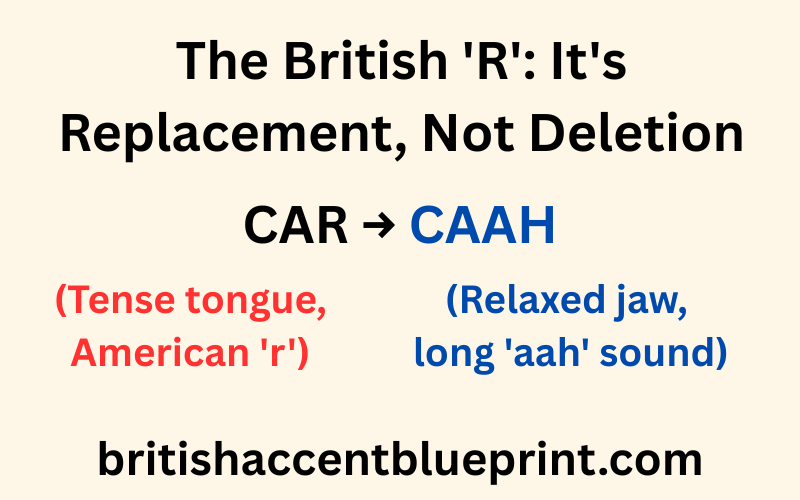
The real secret, the key to that elegant and flowing British sound, is that you don’t just delete the ‘r’ sound. You replace it by changing the quality of the vowel that comes before it. This is a critical distinction that creates the smooth, elegant, and recognisable British sound.
Let’s take our example from before: park the car.
A learner who simply “deletes” the ‘r’ might say: “pak the ca”. This sounds wrong and is a common mistake. It leaves a sonic vacuum where the ‘r’ used to be.
An RP speaker does something much more sophisticated. They merge the vowel and the ‘r’ sound into a single, pure, long vowel sound.
- The ar in ‘park’ becomes a long, open ‘aah’ sound, like the sound you make for a doctor. Your jaw drops, and your tongue is low and relaxed. The word becomes “paahk”.
- The or in ‘more’ becomes a long ‘aw’ sound, like the vowel in ‘thought’. The word becomes “maw”.
- The er in ‘teacher’ becomes a soft, neutral ‘uh’ sound, called a schwa. The word becomes “tee-chuh”.
This is the foundational micro-lesson. Stop thinking about “dropping the r” and start thinking about “changing the vowel.” This single mental shift is the key to unlocking a truly natural sound when you practice the non-rhotic ‘R’.
Let’s Practice: Building the Muscle Memory for the British ‘R’
This is a physical skill, not just an intellectual one. Let’s train the muscles of your mouth. For each pair, first say the word with a hard, tense American ‘r’, feeling the back of your tongue pull up towards the roof of your mouth. Then, say the RP version, focusing on relaxing your jaw, keeping your tongue forward and low, and producing a pure, beautiful vowel sound.
The ‘aah’ sound (/ɑː/)
This is the most common replacement for ‘ar’.
- Card → caahd
- Start → staaht
- Large → laahj
- Farther -> fah-thuh
The ‘aw’ sound (/ɔː/)
This is the replacement for ‘or’.
- Short → shawt
- North → nawth
- Four → faw
- Born -> bawn
The ‘uh’ sound (/ə/)
This is the replacement for ‘er’, ‘ur’ or ‘ir’ in unstressed syllables, especially at the end of a word.
- Better → be-ttuh
- Doctor → doc-tuh
- Player → play-uh
- Water -> waw-tuh
- Bird -> buhd (with a long vowel)
- Turn -> tuhn (with a long vowel)
If you can feel the physical difference between the tense American ‘r’ and the relaxed, open RP vowel, you are on the path to mastery. This is the core physical adjustment your mouth needs to learn.
The Second Piece of the Puzzle: The Linking ‘R’
You now understand the “silent British ‘R’.” But what about when it’s not silent? This is the advanced skill that unlocks truly fluent, connected, native-level speech. This is called the Linking ‘R’.
Remember the rule: “only pronounce the ‘r’ if it is followed by a vowel sound.” This rule applies between words as well as within them, and this is what most learners miss.
When a word ending in a normally silent ‘r’ (like four) is immediately followed by a word starting with a vowel (like or), the ‘r’ magically reappears to form a seamless, elegant bridge.
- The Sentence: “I need four or five.”
- The Learner’s Mistake: “I need faw… aw… five.” (This sounds robotic because of the glottal stop or pause between the vowels).
- The Native Way: “I need faw-ror-five.” (The ‘r’ from ‘four’ links to ‘or’, creating a single, fluid phrase).
This happens everywhere in natural speech and is a non-negotiable skill for fluency. A native speaker doesn’t think about it; it’s automatic. For the learner, it must be a conscious practice until it becomes second nature.
More Examples of the Linking ‘R’ in Action:
- “My tea-che-ri-zold.” (teacher is)
- “Fa-ra-way.” (far away)
- “Neve-ra-gain.” (never again)
- “Whe-ra-my keys?” (where are)
- “For an example…” becomes “Fo-ra-n example…”
Without the Linking ‘R’, you will always sound like you are reading a list of words. With it, you begin to speak in the fluid, connected “chunks” that are the hallmark of a truly advanced speaker.
The ADVANCED Secret Weapon: The Intrusive ‘R’
You’ve now mastered the Linking ‘R’, where a written ‘r’ is pronounced. But to reach the absolute highest level of fluency, you need to know about its mysterious cousin: the Intrusive ‘R’.
What is the Intrusive ‘R’?
This is a fascinating feature of many non-rhotic accents, including RP. Native speakers will often insert an ‘r’ sound to link two words, even when there is no ‘r’ in the spelling.
This might sound like a mistake, but it is a completely standard and widespread feature of natural, connected speech. It follows the same core principle as the Linking ‘R’: it is used to create a smooth bridge between a word that ends in a vowel and a word that begins with one.
Let’s look at the classic example: “law and order.”
- The Learner’s Mistake: “law… and… order.” (A clear, robotic pause).
- The Native Way: “law-r-and order.”
An ‘r’ sound magically appears between “law” and “and” to make the phrase flow smoothly. This happens because “law” ends with the /ɔː/ vowel sound.
More Examples of the Intrusive ‘R’ in Action:
- “The idea of it” becomes “The idea-r-of it.”
- “I saw a film” becomes “I saw-r-a film.”
- “China and Japan” becomes “China-r-and Japan.”
Should You Use It?
This is a point of debate even among native speakers! Some traditionalists consider it “incorrect” or “lazy,” but it is undeniably widespread, even on the BBC.
For a learner, the strategic advice is this: first, learn to recognise it. Understanding the Intrusive ‘R’ will dramatically improve your listening comprehension of fast, natural speech. Second, you can begin to experiment with it in common phrases like “law and order.” It is the final, subtle polish that can make your accent sound truly native.
Your Path Forward
You now have a deep, comprehensive understanding of the complete British ‘R’ system. You know the “what” (the non-rhotic rule), the “why” (it’s the #1 signal of RP), and the “secret” (it’s about vowel replacement). You even understand the advanced fluency techniques of the Linking and Intrusive ‘R’.
This knowledge is the blueprint. But a blueprint is not the building. The next step is to turn this theory into a physical, unconscious skill through consistent, deliberate, and guided practice.
The Next Step: From Knowledge to Muscle Memory
You now have the map. To get the guided tour and turn this knowledge into a real skill, you need to drill. To accelerate your results and get expert video coaching, I’ve made Day 1 of my premium video course available for free. It is a complete, high-intensity deep-dive on this exact non-rhotic ‘R’ system, packed with call-and-response exercises.
It’s where you’ll find the advanced drills needed to truly master this sound and begin your transformation from learner to confident speaker.
► Get your FREE video lesson now at: https://britishaccentblueprint.com/preview
P.S. This entire system of mastering the British accent is based on the principles in my book, The British Accent Blueprint. If you prefer to learn from a comprehensive, step-by-step written guide that covers all the other sounds of RP, you can get your copy on Amazon here.