Mastering the British ‘T’ Sound is often the final hurdle for learners who have already tackled the silent ‘R’. You’re starting to feel the flow of Received Pronunciation (RP), but then you hit a word like “water”, “better”, or “important”, and suddenly, you’re stuck.
If you pronounce a hard, crisp ‘T’ every single time, you risk sounding like a character from a 19th-century period drama – overly formal and slightly detached from modern reality. However, if you drop the ‘T’ entirely in the wrong place, you lose the crispness and clarity that makes the British accent so prestigious.
The British ‘T’ is not a single sound; it is a strategic choice. Knowing when to use a “True T” and when to use the “Glottal Stop” is the secret to finding that sweet spot between being perfectly understood and sounding effortlessly natural. In this definitive guide, we will dismantle the mechanics of the ‘T’, explain the “Glottal” controversy, and provide the exact roadmap to mastering these sounds in your daily speech.
The Two Faces of the British ‘T’
In many languages, a letter represents one sound. In British English (specifically RP), the letter ‘T’ is a chameleon. It changes based on where it sits in a word, which letters surround it, and even the speed at which you are speaking.
To the untrained ear, it might seem random. To the master of the “Blueprint”, it is a logical system. There are two primary versions of the ‘T’ that you must master:
- The True ‘T’ (Aspirated): This is the sharp, clear, percussive sound.
- The Glottal Stop: This is the “missing” sound, where the airflow is cut off in the throat.
Mastering the British accent isn’t about choosing one over the other; it’s about knowing how to toggle between them with surgical precision.
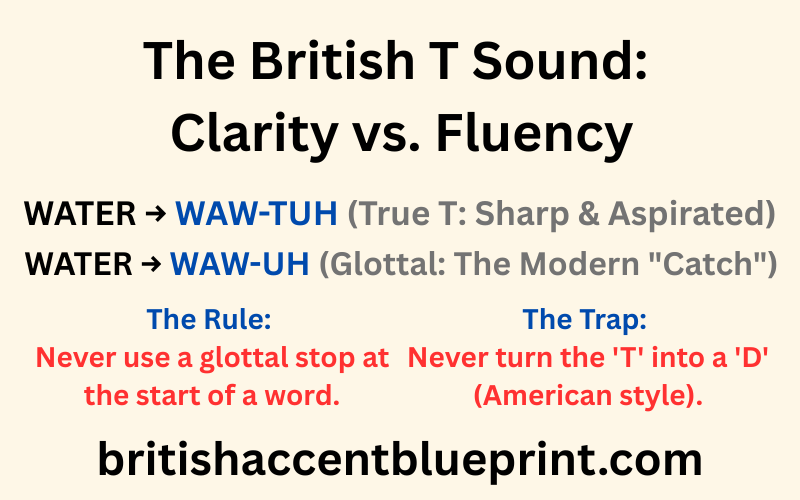
The True ‘T’: The Sound of Authority and Clarity
In Received Pronunciation, the True ‘T’ is what we call “aspirated.” This means that when you release the tongue from the roof of your mouth, a small burst of air escapes. If you hold a piece of paper in front of your mouth and say the word “Tea”, the paper should move.
The Mechanics of the True ‘T’:
To produce this sound correctly, place the tip of your tongue against the alveolar ridge (the bony bump just behind your upper front teeth). Build up a tiny pocket of air pressure behind the tongue, then release it sharply.
Where to use it:
- At the beginning of words: Time, Table, Two, Today.
- At the beginning of a stressed syllable: Hotel, Attend, Italian.
- When you want to emphasise a point: In formal speech, even ‘Ts’ that could be glottalised are often turned back into True ‘Ts’ for maximum authority.
If you fail to aspirate your ‘Ts’, your accent will sound “flat.” The aspiration is what gives the British accent its famous “clicky” and rhythmic quality.
The Glottal Stop: Modern Fluency vs. Regional Slang
The Glottal Stop (symbolised in phonetics as /ʔ/) is perhaps the most misunderstood sound in English. For decades, it was dismissed as “lazy” or “lower class.” In 2026, that is no longer the case. Even in the most prestigious circles, the glottal stop is a standard tool for fluid, connected speech.
What is it exactly?
A glottal stop is not a “dropped” letter. You aren’t simply ignoring the ‘T’. Instead, you are stopping the air in your glottis (the space between your vocal cords) rather than using your tongue against your teeth. It sounds like a tiny, sharp catch in the throat.
Think of how an English person might say “football”. It isn’t “foot-ball” with a sharp ‘T’, and it isn’t “foo-ball” with a long vowel. It’s “foo(stop)ball”.
The Critical Rule: When to Use Which?
This is the section that separates the “Blueprint” from generic advice. You must follow these three rules to avoid sounding unnatural:
Rule 1: The “Initial” Rule
Never, under any circumstances, use a glottal stop at the beginning of a word. Saying ” ‘ime” instead of “Time” is not an accent; it is a speech error. Initial ‘Ts’ are always True ‘Ts’.
Rule 2: The “Consonant” Rule
If a ‘T’ is at the end of a syllable and is followed by a consonant, the glottal stop is your best friend.
- Example: “Network” becomes “Ne(stop)work.”
- Example: “Apartment” becomes “Apar(stop)ment.”
- Example: “Scotland” becomes “Sco(stop)land.”
Rule 3: The “Vowel” Rule (The RP Buffer)
This is where RP differs from “Cockney” or “Estuary” accents. In traditional RP, if a ‘T’ is between two vowels (like in “Water” or “City”), you should use a True ‘T’.
However, in Modern RP, it is becoming increasingly common to use a soft glottal stop here in casual conversation. As a learner, my advice is to stick to the True ‘T’ between vowels to maintain your “Gold Standard” clarity.
The “American Trap”: Why the ‘T’ Never Becomes a ‘D’
If you have studied General American English, you have likely learned the “Flap T”. This is the habit of turning a ‘T’ into a ‘D’ sound when it’s between vowels. In America, “Water” sounds like “Wawduh”.
In the British Accent Blueprint, this is a forbidden move.
In any form of British English, a ‘T’ remains a ‘T’. It is either a sharp, aspirated sound or a glottal stop. It never, ever becomes a ‘D’. Turning your ‘Ts’ into ‘Ds’ is the fastest way to reveal yourself as a non-native or an American speaker. If you want to sound British, you must keep the ‘T’ voiceless.
Advanced Connected Speech: The ‘T’ as a Bridge
Just like the “Linking R” we discussed in my previous guide, the ‘T’ plays a massive role in how words stick together.
When a word ends in a ‘T’, and the next word starts with a vowel, the ‘T’ often migrates to the start of the next word.
- Example: “Not at all” becomes “No-ta-tall.”
This creates a percussive, machine-gun-like rhythm that is characteristic of high-level RP speakers. If you pause between these words, you lose the “music” of the accent.
Practical Drills for Muscle Memory
To reach the level of mastery, we must move from the head to the mouth. Read these sentences aloud, focusing on the specific ‘T’ behaviour.
Drill 1: The Aspirated Initial T
- Take the time to talk today. (Focus on the puff of air on every ‘T’).
- Two tall teachers taught.
Drill 2: The Glottal Stop (Before Consonants)
- It’s a bright, hot night in Scotland. (Apply the throat-stop on ‘bright’, ‘hot’, ‘night’, and ‘Scot’).
- I hate that football shirt. (Stop the air on ‘hate’, ‘that’, and ‘foot’).
Drill 3: The Intervocalic True T (The RP Signature)
- The city water is better. (Focus on the crisp, sharp ‘T’ in ‘city’, ‘water’, and ‘better’).
- A little bit of butter.
Your Path Forward
Mastering the British ‘T’ sound is about more than just “pronouncing things correctly.” It is about adopting the rhythmic DNA of the language. By balancing the sharp clarity of the Aspirated ‘T’ with the modern efficiency of the Glottal Stop, you transform your speech from a series of individual words into a flowing, authoritative stream of communication.
The Next Step: From Theory to Practice
You now have the “what” and the “why.” You understand the mechanics of the ‘T’ more deeply than 99% of learners. But as I always say: A blueprint is not the building.
To turn this intellectual knowledge into a physical, unconscious habit, you need to hear the sounds, mimic the mouth positions, and engage in guided repetition.
To accelerate your results and see exactly how I position my tongue and throat for these sounds, I’ve made Day 1 of my premium video course, The 7-Day British Accent Accelerator, available for free.
► Get your FREE video lesson now at: https://britishaccentblueprint.com/preview
P.S. If you want the full, unabridged written system for every vowel and consonant in the RP accent, you can find the complete guide in my book, The British Accent Blueprint, available on Amazon.