You’ve seen it in films. You’ve heard it on the BBC. That clear, confident, and effortlessly classy way of speaking that is instantly recognisable as ‘British’. Many dedicated English learners, perhaps just like you, spend years trying to capture that sound, only to end up frustrated, confused, and no closer to your goal.
The problem? You’ve been chasing a ghost.
The single biggest myth holding learners back is the idea that there is one, single ‘British accent’. I’m here to tell you that’s not true. But I’m also here, as a non-native speaker who has successfully mastered this skill, to tell you that the specific, prestigious accent you’re almost certainly looking for is a real, learnable system.
In this definitive guide, we will dismantle the myth of the ‘British accent’, identify the exact target you should be aiming for, and give you an in-depth micro-lesson on the single most important sound you must master to achieve your goal. This isn’t a quick tip; this is the foundational key to the entire accent.
The Expert’s Trap: A Tapestry of Accents
Right then, let’s clear up the biggest point of confusion. The United Kingdom is a linguistic minefield, a tapestry of dozens of distinct, fascinating regional accents. Someone from Liverpool (a Scouse accent) sounds completely different from someone from Newcastle (a Geordie accent). A person from Glasgow, Scotland, sounds nothing like a person from Cardiff, Wales, or Belfast, Northern Ireland.
Even within London, a city of nine million people, the diversity is astonishing. You can find the traditional Cockney accent, famous from films like Mary Poppins, just a few miles from the modern, multicultural accents of the city’s youth, often called Multicultural London English. Travel west and you’ll hear the beginnings of what’s called an Estuary accent.
Linguistically, this is fascinating. For a learner, it’s a nightmare. If you ask ten different Brits to teach you a “British accent,” you might get ten different versions. This is the expert’s trap: being so technically correct (“There’s no such thing!”) that you become practically unhelpful. Unless your specific goal is to sound like a character from the TV show Peaky Blinders (a Birmingham accent) or Game of Thrones (a Yorkshire accent), you need a more focused, practical target. You need an accent that serves your real-world goals of clarity, confidence, and international communication.
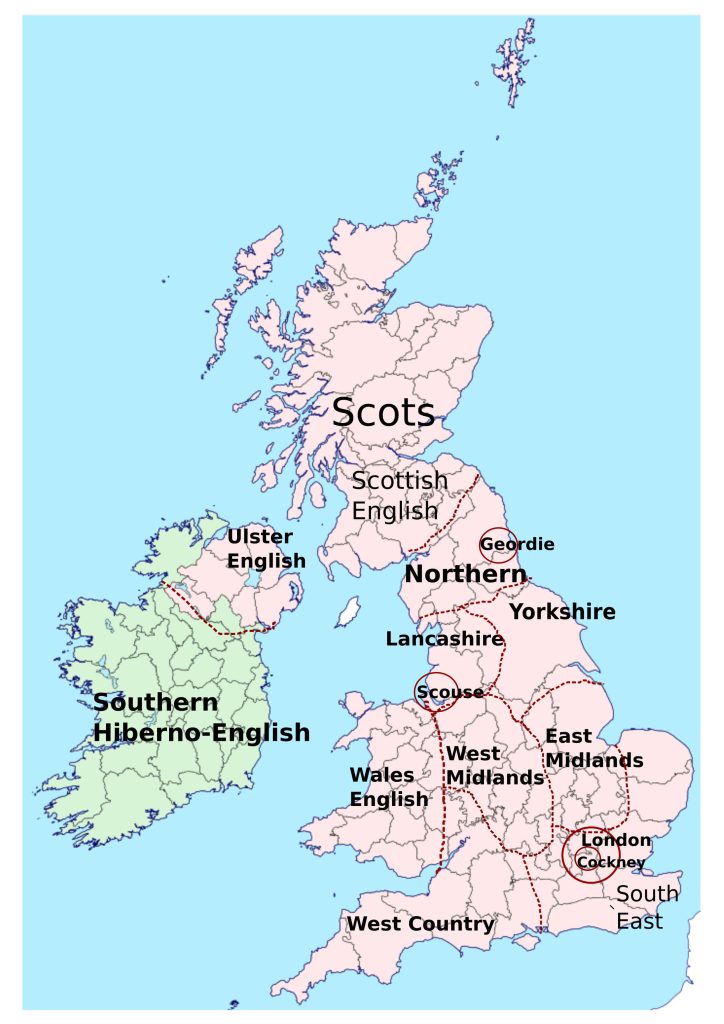
Image by Maunus at English Wikipedia, licensed under CC BY-SA 3.0
The British Accent You’re Actually Looking For: Received Pronunciation (RP)
For 99% of learners who want to master a ‘British accent’, the accent you are dreaming of has a specific name: Received Pronunciation, or RP for short.
What is RP, and Why Should You Learn It?
- It is the accent of international communication. It’s the voice you hear from BBC newsreaders, in international business, and in global diplomacy. It is instantly understood from London to Lagos to Tokyo. It is the ‘gold standard’ of British English for clarity.
- It is the accent of prestige and education. It’s the accent of the Royal Family, of Oxbridge professors, and of actors trained at the world’s most prestigious drama schools like RADA.
- Crucially, RP is considered regionally neutral. It doesn’t belong to a specific city or county. It is an accent of education, not geography. This makes it a powerful and versatile tool for any non-native speaker who wants to sound clear, credible, and confident without adopting a specific regional identity that might not feel authentic to them.
Some call it “The Queen’s English” or “BBC English,” but the principle is the same. It is the accent that projects clarity and authority on a global stage. And the best part? It is not a birthright. It is a system of sounds, rules, and musicality that can be learned, practised, and mastered. I know this because, as a non-native speaker myself, I have walked this exact path from frustration to fluency.
The #1 Sound That Defines RP: A Deep Dive into the Non-Rhotic ‘R’
So, where does the journey to RP begin? It starts with the single most important and instantly recognisable feature of the accent: the non-rhotic ‘R’.
Mastering this one concept is the first major step to sounding authentically British. It’s the clearest signal that separates RP from a standard American accent, and getting it right will have a bigger impact on your sound than any other single change.
What is a Non-Rhotic ‘R’?
The rule is simple: in RP, you only pronounce the letter ‘r’ if it is followed by a vowel sound. If the ‘r’ comes before a consonant (like in ‘park’) or is at the very end of a word (like in ‘car‘), it is silent.
But here is the real secret, the part most learners miss: you don’t just drop the ‘r’. You replace it by lengthening the vowel sound that comes before it. This is a critical distinction that creates the smooth, flowing, and ‘classy’ sound of RP.
Let’s look at a simple example: the word car.
- An American speaker pronounces the ‘r’ with a hard, constricted sound at the back of the throat. The tongue pulls back and tenses. It sounds like “carr“.
- An RP speaker does two things: they remove the ‘r’ sound completely, and they stretch the vowel into a pure, open ‘ah’ sound. The tongue stays relaxed and forward. The word becomes “caah”.
This is not a subtle difference. It is a fundamental shift in the music of the language. You don’t park your ‘car’; you ‘paahk’ your ‘caah’.
Let’s Practice (The “What” and “Why”):
Feel the difference in your own mouth. This is a physical skill, not just an intellectual one. First, say these words with a hard American ‘r’, feeling the tension in the back of your tongue:
- Hard
- More
- Order
- Chair
Now, say them the RP way. Relax your jaw, drop the ‘r’ completely, and focus on creating a pure, beautiful vowel sound.
- “haahd”
- “maw”
- “aw-duh”
- “cheh-uh”
That transformation is the very foundation of the accent. It is the first and most critical piece of muscle memory you must build. But this is only half the story.
The Other Half of the ‘R’ Rule: The Secret to Sounding Fluent
Remember the rule: pronounce the ‘r’ if it’s followed by a vowel sound. This is where the magic of connected, fluent speech happens. This is called the Linking ‘R’, and it’s what separates intermediate learners from advanced, natural-sounding speakers.
When a word that normally has a silent ‘r’ at the end (like car) is immediately followed by a word that starts with a vowel (like is), the ‘r’ magically reappears to create a smooth, seamless bridge between the two words.
- The Sentence: “My car is old.”
- The Learner’s Mistake: “My caah… iz… old.” (This sounds robotic and unnatural because of the pause).
- The Native Way: “My ca-riz-old.” (The ‘r’ from ‘car’ links to ‘is’, eliminating the pause).
This is a non-negotiable rule of fluent RP. Let’s look at another example:
- The Sentence: “It is far away.”
- The Native Way: “It is fa-ra-way.”
And another:
- The Sentence: “Where are you?”
- The Native Way: “Whe-ra-you?”
Without this linking ‘r’, your speech will always sound disjointed, like you are reading a list of words instead of speaking a sentence. Mastering it is the difference between knowing the sounds and truly speaking the accent.
(YouTube Video)
Your First Step to an Authentic Accent
You now understand the single biggest secret to acquiring a prestigious British accent: stop chasing a vague idea and start mastering a specific, proven system. That system is Received Pronunciation, and its foundation is the intelligent use of the non-rhotic ‘R’ and its fluent cousin, the Linking ‘R’.
This isn’t about erasing your identity; it’s about adding a powerful new tool to your communication toolkit. It’s about achieving the clarity and confidence you deserve, so that no one ever has to ask you to repeat yourself again. Mastery is a journey, not a destination, but it begins with a single, correct step.
You’ve just taken that step.
The Next Step: From Theory to Practice
You now have the “what” and the “why.” You understand the theory of the most important sound in RP more deeply than 99% of learners. But theory alone does not create a new accent. For that, you need high-intensity, guided practice to build the deep muscle memory that makes the sound automatic and unconscious.
To get the “how” – the complete set of video drills and expert coaching to turn this knowledge into a physical skill – you need to train.
To accelerate your results, get free instant access to Day 1 of my premium video course, The 7-Day British Accent Accelerator. It’s where you’ll find the advanced, call-and-response drills to master this ‘R’ sound and truly begin your transformation.
► Get your FREE video lesson now at: https://britishaccentblueprint.com/preview
P.S. This entire system of mastering the British accent is based on the principles in my bestselling book, The British Accent Blueprint. If you prefer to learn from a comprehensive, step-by-step written guide, you can get your copy on Amazon here.